How to Restore Disk Backup Image with AOMEI Backupper?
When the hard drive corrupts or damages, we should think about the possibility of recovery disk backup image that contains the operating system, installed software, games, applications as well as personal files.
In general, we need to do disk restore in the following situations:
-
Your system files have been damaged by a virus or malware and cannot boot normally.
-
Your current hard drive has failed or is showing signs of failing and you want to replace it.
-
Your current hard drive is too small and you want to change to a bigger one.
-
Your data on the hard disk has been lost and you want to recover it.
-
You want to replace hard drive with SSD and benefit from new technology.
All these situations are based on one thought: you don't want to reinstall everything. As long as you have a backup image of the hard drive, you can achieve this.
Now, let's start to understand how to restore a disk image. First, Download, install and launch this software.
How to Restore Disk with AOMEI Backupper in Windows Step by Step
Prerequisites for disk restore
Before restoration, there are some things you need to know.
AOMEI Backupper disk restore is based on AOMEI Backupper disk backup. You should already have at least one disk image made by AOMEI Backupper (whatever the source disk is, the current crashed one or a disk on another computer). Even if you have several Windows backup points, it won't work. AOMEI Backupper does not recognize disk images made by Windows or other software.
If you haven't created a disk backup with AOMEI Backupper, you can create one based on another working disk. However, after restoration, the disk of the recovered computer will be a copy of the disk you just backed up, not the crashed one. You can choose this method if viable.
Nominally, users should recover using the disk Backup image created on their current failed disk. If the PC fails to boot or has crashed, you can create a WinPE bootable media using AOMEI Backupper or AOMEI PE Builder on another healthy computer and then boot the crashed PC from the WinPE bootable media to run the disk restore under WinPE.
We strongly recommend that users create a WinPE bootable media once they start to use AOMEI products. Such bootable media should be created and kept in a safe place in order to boot a failed computer. Otherwise, not having the required bootable media might result in not being able to recover your computer at all.
If you don't have these items, please download AOMEI Backupper and prepare what you need.
Step 1: Initialize Restore
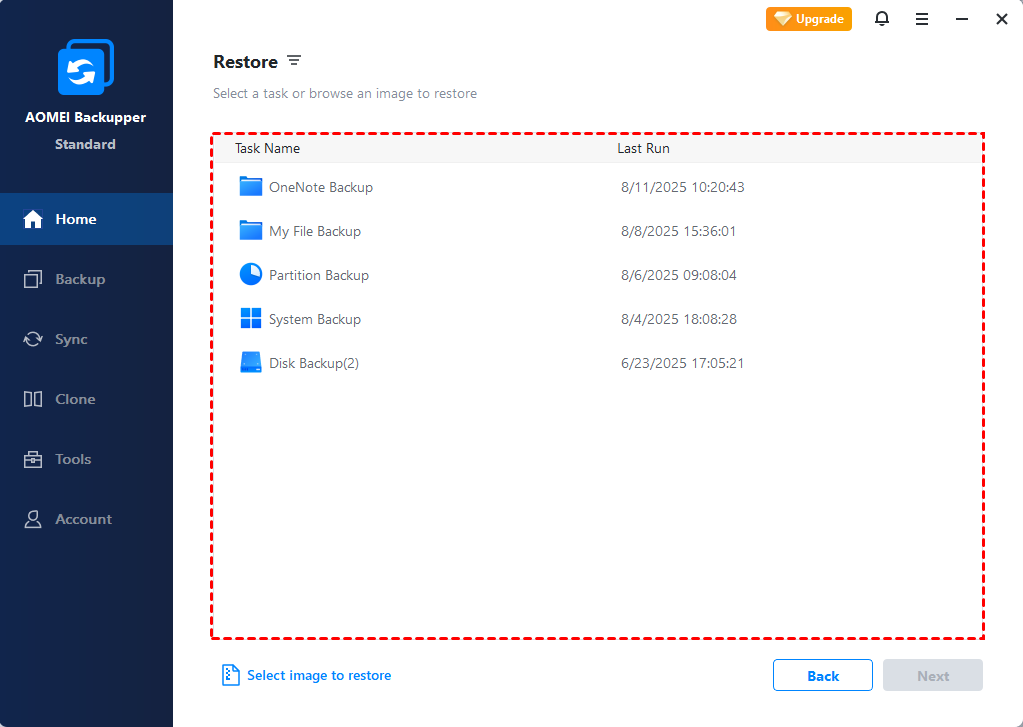
In the left "Home" tab, click Restore.
And then, you can either select a backup task or browse an image to restore. (Here, we take "Select a task to restore" as an example.)
From the listed backup tasks, select the disk backup task you want to restore and click Next to continue.
Step 2: Select Task or Image
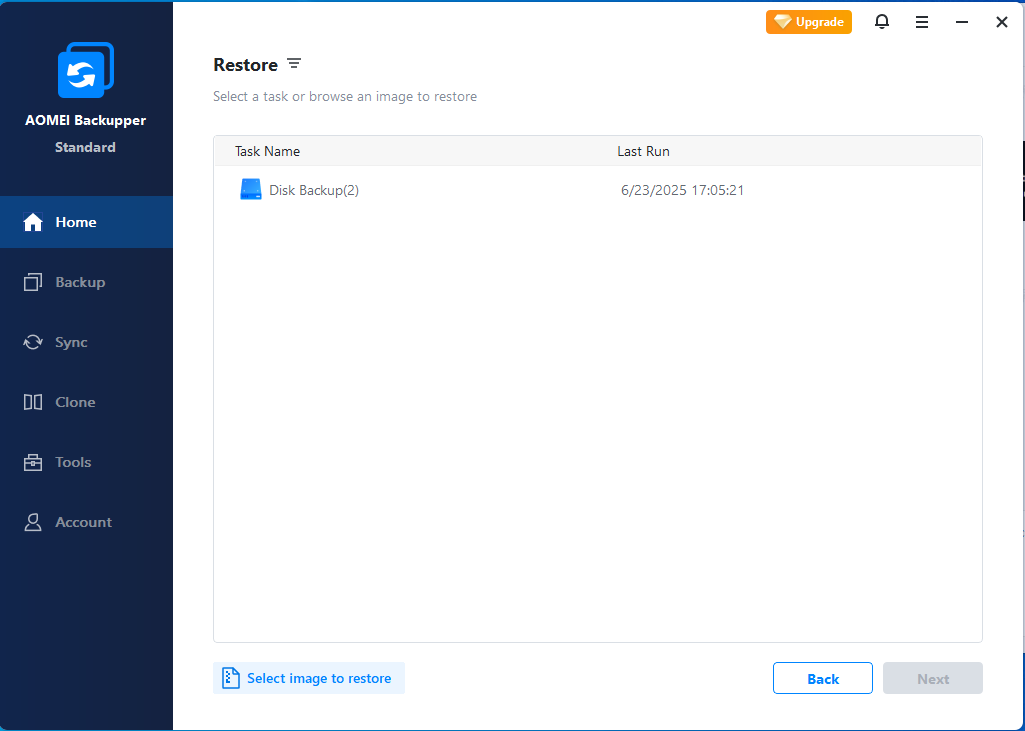
Select a disk backup task or disk backup image and click the Next button.
Step 3: Select Source
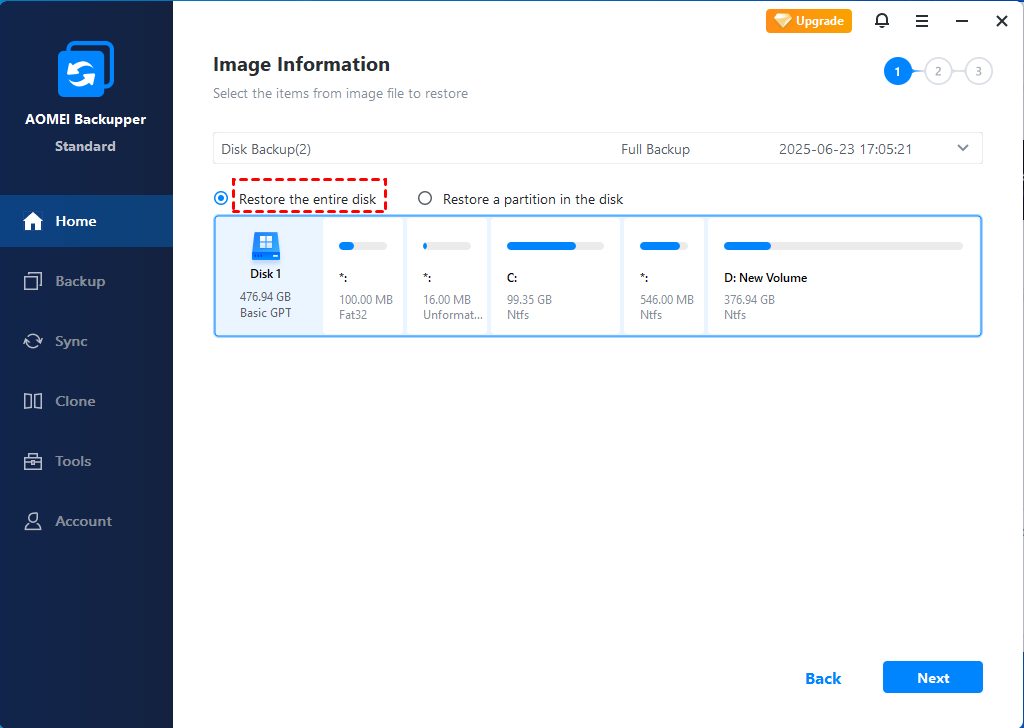
Select to restore the entire disk or a partition and then click Next.
Tips: If it is a system disk backup, to make a bootable restore, please select "Restore the entire disk".
Step 4: Select Destination
Select a destination disk to restore the backup image to.

Tips: The destination partition will be overwritten. Please backup files in advance.
Step 5: Start Restore
In the "Operation Summary" page, preview the operation that will be executed. Click Start Restore after confirmation. Wait for the process to complete, and then click OK.
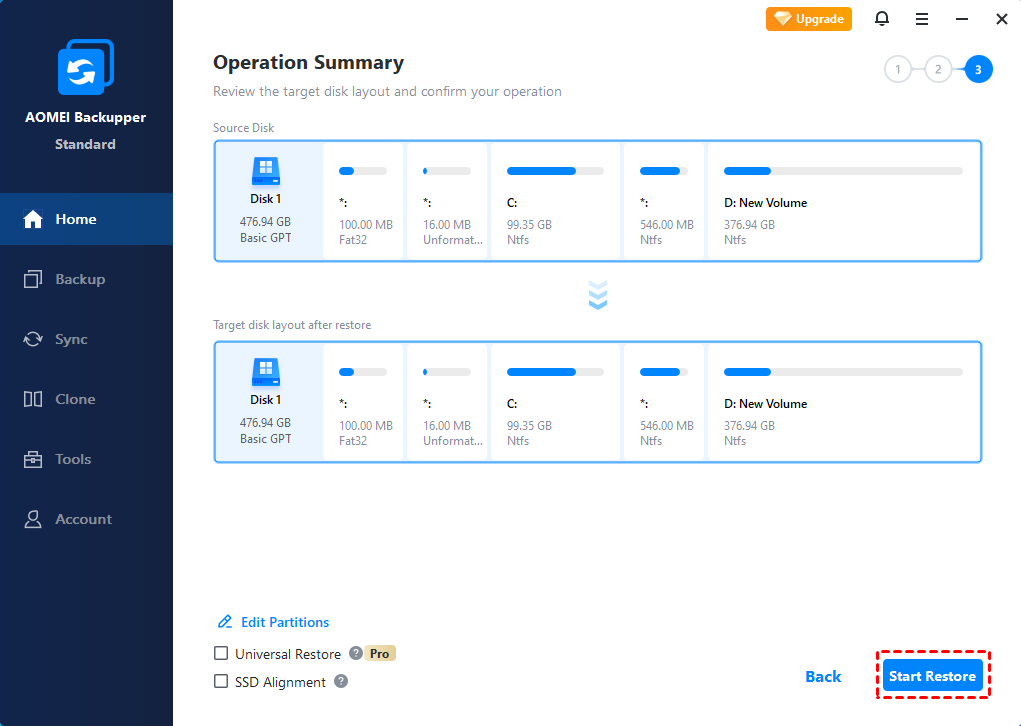
Tips: You can learn more in "Edit Partitions" and "SSD Alignment" and "Universal Restore".
For more details with screenshots, see: Disk Recovery with AOMEI Backupper.
How to Restore System under WinPE
If the PC fails to boot or has been crashed, you need to create a WinPE bootable media with AOMEI Backupper and boot your PC into WinPE to run the disk restore.
Please follow the steps below:
( It is mainly used for the current system disk backup image, so you can boot your system after image restore.)
Step 1: Create Bootable Media on Working PC
Please create a WinPE bootable media using AOMEI Backupper or AOMEI PE Builder on another healthy computer.
Step 2: Boot the Failed PC
Then, insert the bootable media into the failed computer and boot from it. ( You may need to change the boot sequence and Boot Mode in the PC's BIOS (Also referred to as UEFI).
Step 3: Restore Disk in WinPE
When the PC boots up successfully, AOMEI Backupper (already installed on the bootable device) will run automatically, allowing you to start the disk recovery just as the process under Windows.
Step 4: Boot after Successful Restore
Remove the bootable media and restart your PC after the disk restore is finished successfully. ( You may still need to change the boot sequence and Boot Mode in the PC's BIOS (Also referred to as UEFI).
Notes:
-
If you back up the disk in incremental mode, please prepare the full backup and all related incremental images; If you back up the disk in differential mode, please prepare the full backup and the latest differential image; If you just back up the disk once, only the full backup image is required.
-
If you regularly back up your disks, each backup will generate an image at a given time, so there may be multiple time points to choose from.
-
The destination disk/partition will be totally overwritten. If the destination contains any important data, it should first be copied to another location.
-
If any applications are running on the destination partition/disk, AOMEI Backupper will require you to restart the computer and execute the restore operation in "Restart Mode".
-
When you restore the disk image from a GPT format disk with 5 (or more) partitions to an MBR format disk, it will prompt you that only 3 partitions can be restored because MBR disks only support 4 primary partitions; however, AOMEI Backupper can’t convert primary partitions to logical ones automatically. In this case, you can convert the target MBR disk to GPT with Windows Disk Management or AOMEI Partition Assistant and then restore.
-
If you back up multiple disks to an image file, you can only select one disk to restore at a time.
-
For Disk Backup, you can select a single partition from the disk image to restore.
- By the way, AOMEI Backupper Professional and higher versions support restoring backup images to dissimilar hardware. That is to say, you can restore the disk image taken from one computer to another computer with the help of this software. For detailed steps on dissimilar hardware restore, please refer to OS migration to dissimilar hardware. This software also allows you to restore system images, partition images, and file images. Selective file restore can help restore particular files in the image instead of the entire image.
Conclusion
Disk Restore can help you recover data, restore systems, perform disaster recovery, simplify system migrations and upgrades, and save time and costs. It is an effective method of data recovery and system maintenance, providing you with the security to ensure the safety, reliability, and continuity of your data and systems.
FAQs
Q: Why is there no "Universal Restore" when restoring a disk image?
A: Please check if the disk you backed up is a system disk; if not, "Universal Restore" is unavailable when doing a restore.