How to Run Mirror Sync with AOMEI Backupper
Mirror sync is a feature that ensures the newly added and modified files in the source directory will be synchronized to the target directory, and the files in the target directory will always be exactly the same as the files in the source directory. Files in the target directory that are inconsistent with those in the source directory will be deleted or overwritten.
File mirror sync is commonly used in the following scenarios:
Data Backup: By mirroring files to backup media or backup locations, redundant storage and data protection are achieved. In case of data loss or damage to the source files, the mirrored copy can be used for data recovery.
File Copying and Distribution: When there is a need to copy files between different systems or locations, file mirroring synchronization ensures that the copied files match the content of the source files exactly. This is useful in scenarios such as file distribution, file sharing, and file migration.
Data Synchronization: Maintaining data consistency across distributed systems or multiple nodes is a critical task. By using file mirroring synchronization, file replicas on different nodes can be kept synchronized, enabling the system to operate and compute based on the most up-to-date data.
How to Mirror Folders in Windows 11, 10, 8, 7 Easily
Prerequisites for Mirror Sync
- Download AOMEI Backupper Professional or higher version.
- Prepare a file to test
Step 1: Initiate Mirror Sync
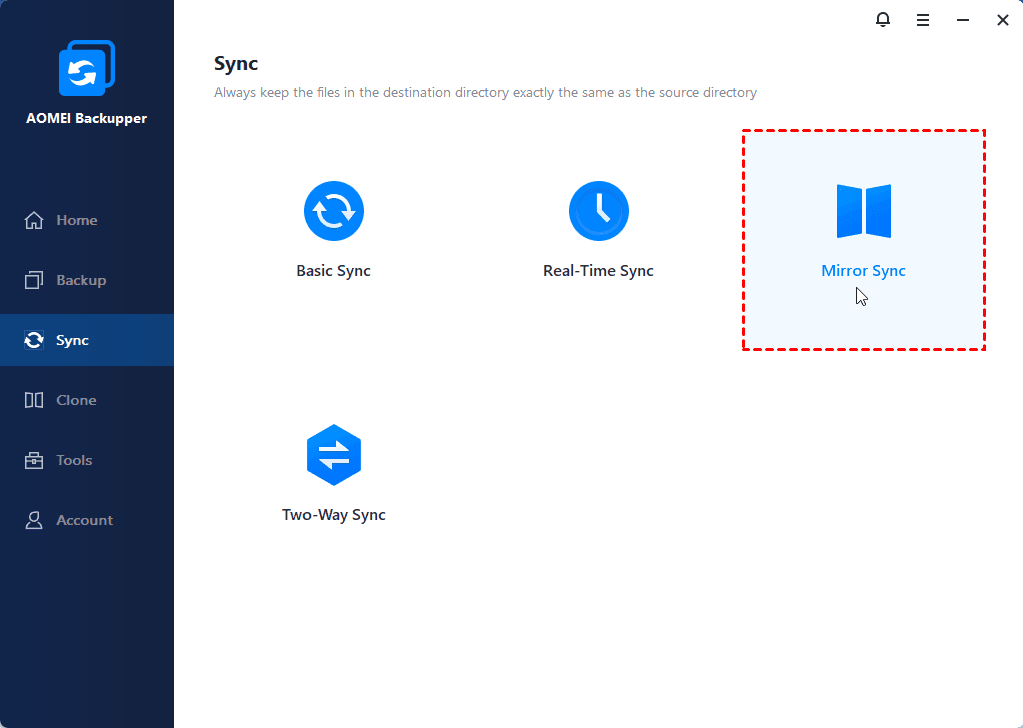
Click the "Sync" tab on the left side and then select "Mirror Sync".
Step 2: Add Folder as Source
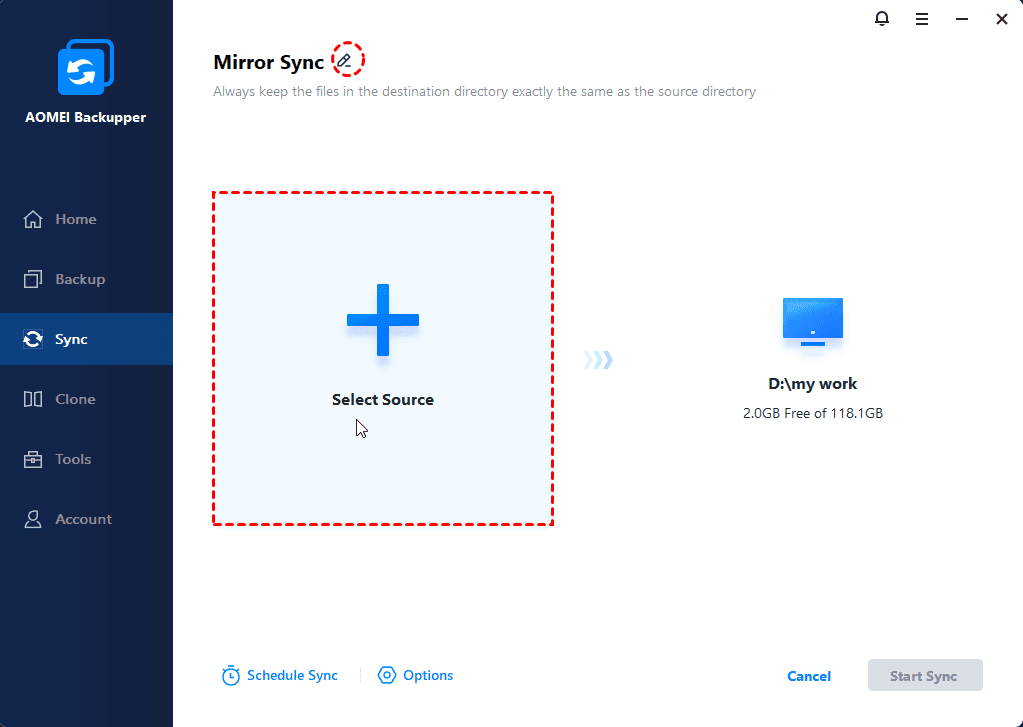
You can click the edit icon to modify the name of this Mirror Sync task to help you distinguish it from other sync tasks. Click "Select Source" to select the folders you want to synchronize. (You can tick and add multiple folders as the source.)
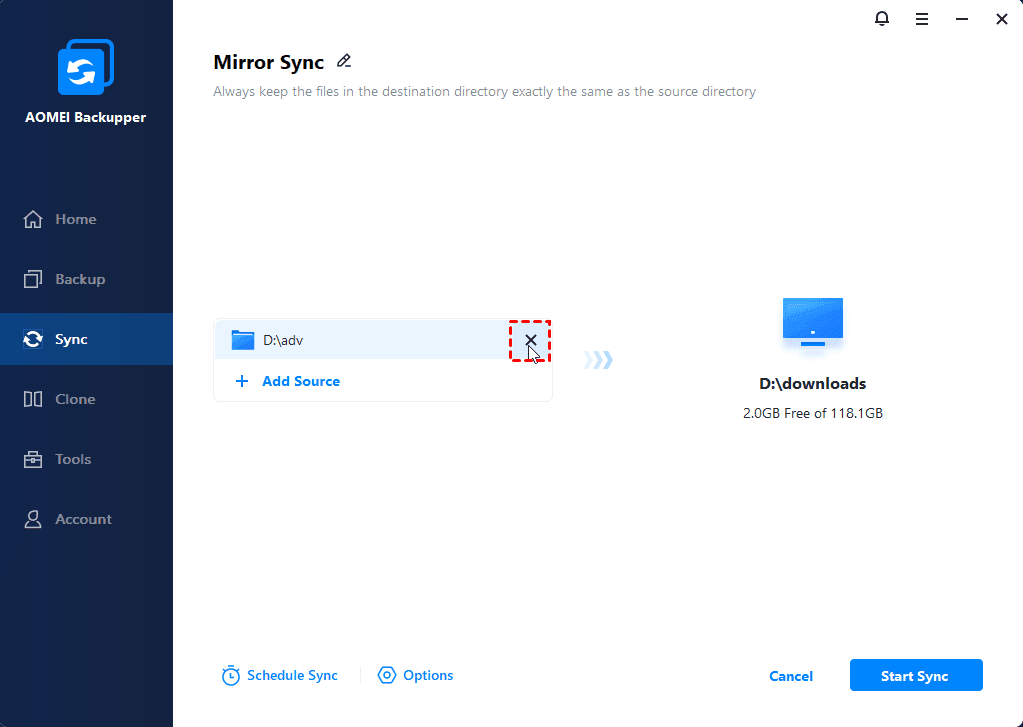
Tips: You can add multiple folders, and you can also remove the wrongly selected folders.
Step 3: Select Destination Location
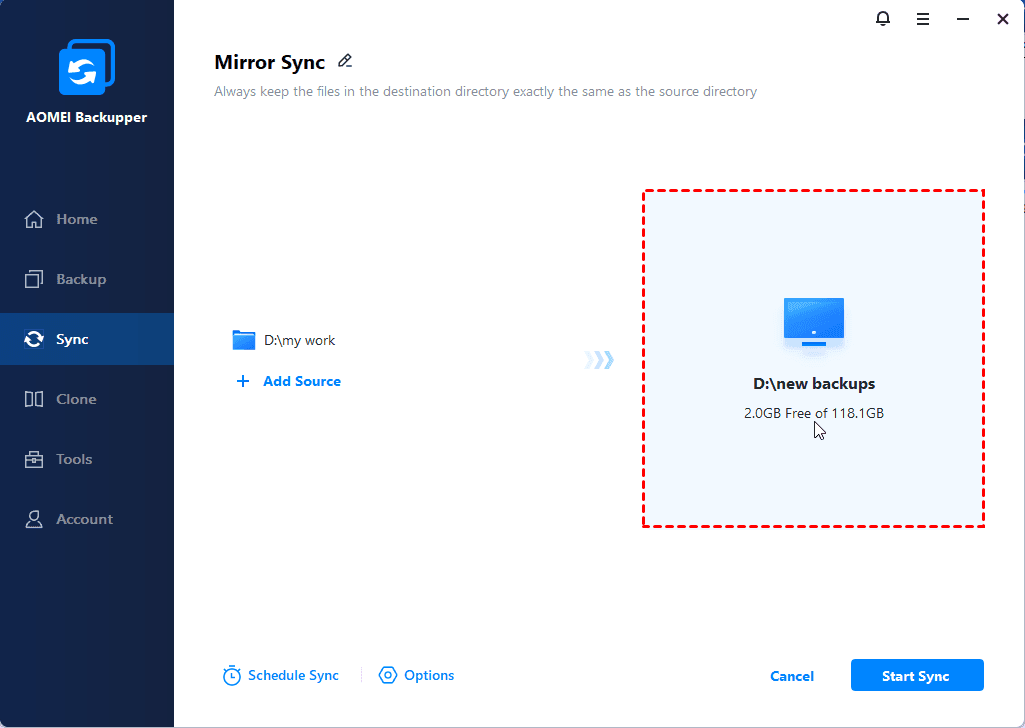
Select a destination location to store the source folder.
Sync Settings (Optional)
When creating a new Mirror Sync task, you will find a "Options" button in the lower-right corner of the interface.
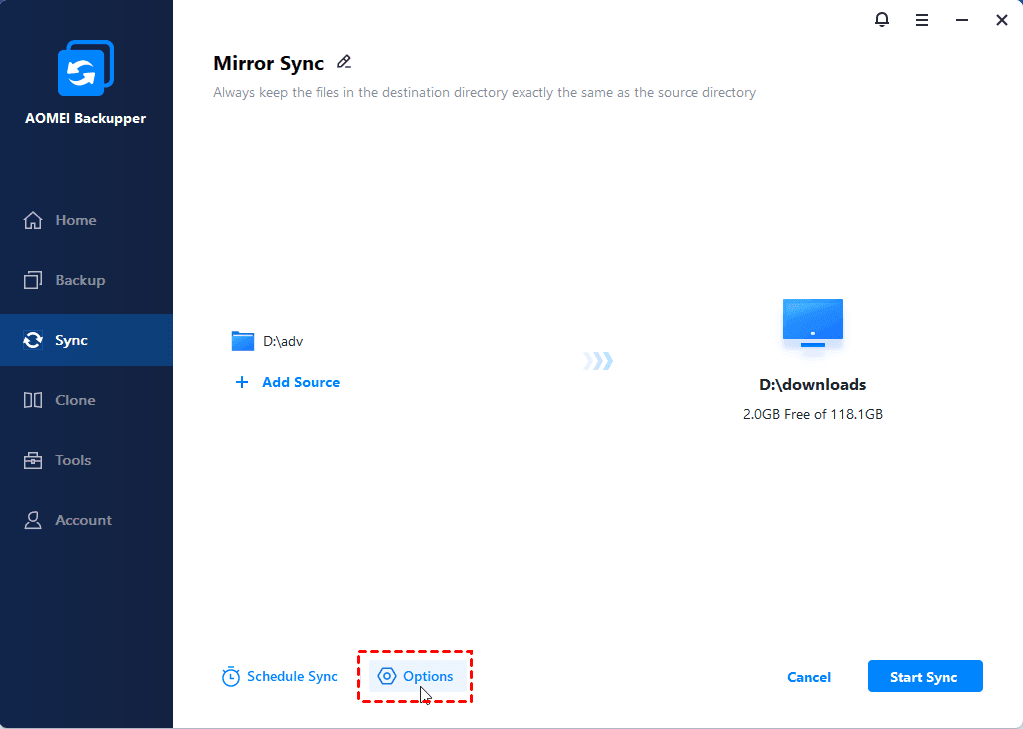
Click the button and you will show "Sync Settings", "Schedule Sync", "Notifications",and "Advanced" options.
Sync Settings
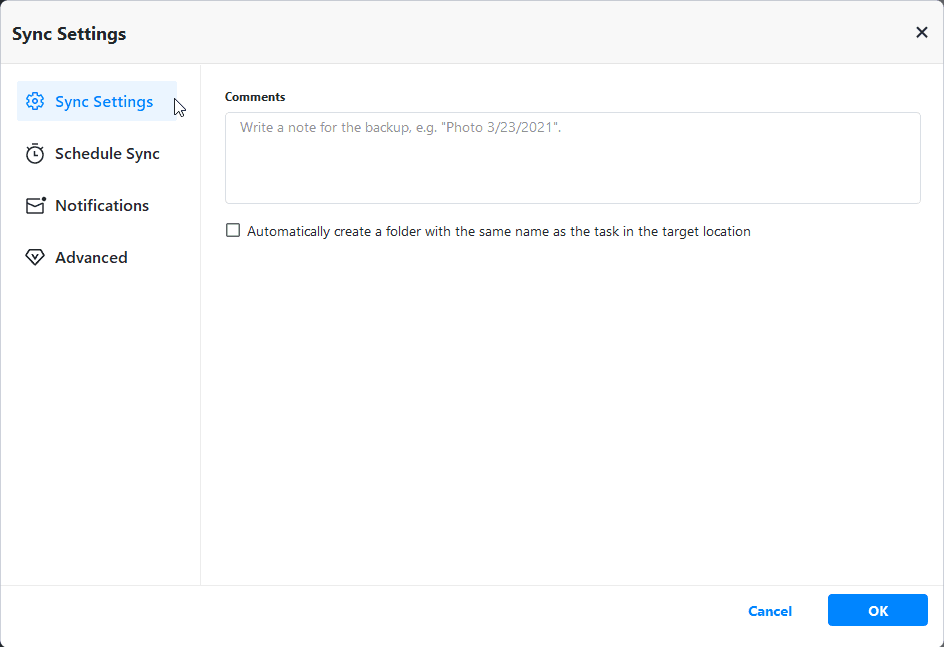
- Comments: Write a note for your task to help you distinguish it from other backup tasks.
- Automatically create a folder with the same name as the task in the target location: After checking this option, when the sync task is executed, a folder with the same name as the task will be automatically created under the target location, and the synchronized files will be stored under this folder.
Schedule Sync
Schedule the required sync task to sync files Daily (By Interval), Daily, Weekly, Monthly (By Week), Monthly (By Week), etc. Also, Event triggers can also be used as a sync method. Please click here to know more details.
Notifications
After enabling this option, email notifications will be sent containing sync results.
Advanced
-
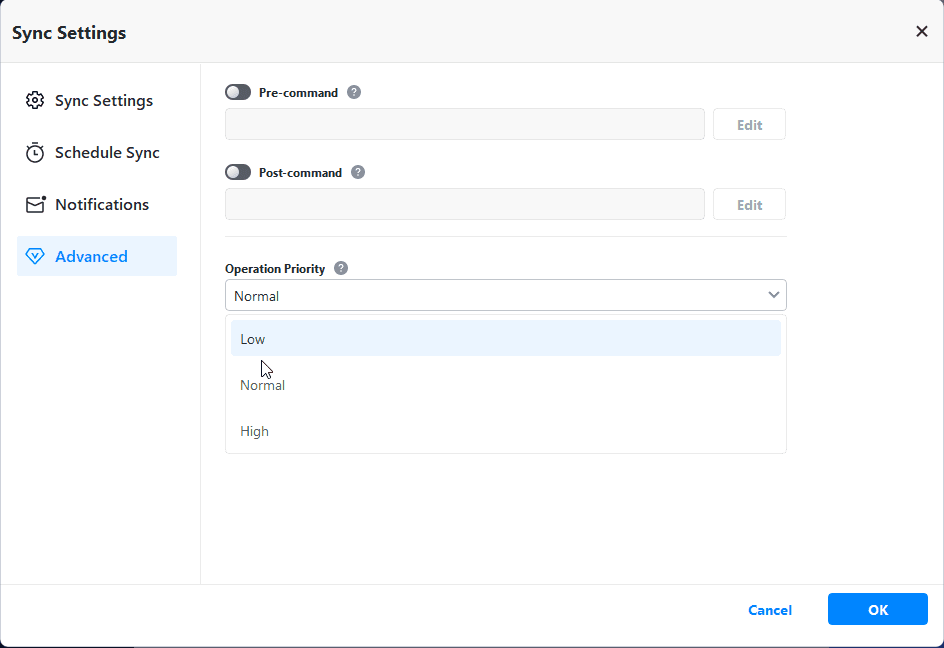
Command: In this option, you can set the pre-command and post-command so that it will run the specified program or script before or after synchronization.
-
Operation Priority: Please select the operation priority of the task. The higher the priority it is, the faster the task execution speed will be.
Step 4: Start Sync
Click "Start Sync" to launch the syncing process.
Tips:
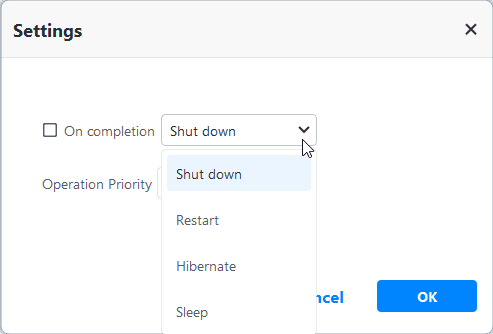
- While sync is running, you can click an icon in the lower-left corner to set to Shut down/Restart/Hibernate/Sleep PC after sync completion.
Step 5: Finish Sync
Please kindly wait for the sync process to complete and then click the "OK" button.

Step 6: Sync Result
As a result, you can view the data directly at the destination location.
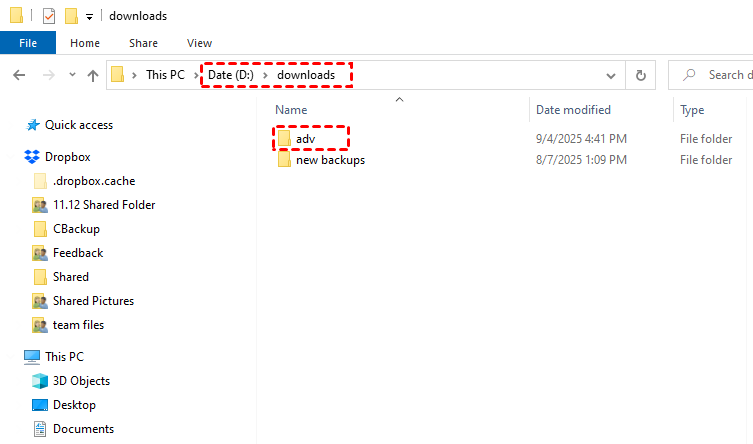
Different Results referring to Different Operations:
-
After creating a mirror synchronization task and running it once, the files in the source directory and the target directory will become exactly the same.
-
If you edit the files in the source directory and then run the mirror synchronization, the files with the same name in the target directory will be overwritten/replaced by the edited files in the source directory.
-
If you edit a file in the target directory and run mirror synchronization, the file will also be overwritten/replaced by the file with the same name in the source directory.
-
If you run mirror synchronization after adding a file in the source directory, the file will be copied to the target directory to keep it exactly the same as the file in the source directory.
-
If you add a new file to the target directory and run mirror synchronization, the file will be deleted to keep it exactly the same as the file in the source directory.
-
If you delete a file from the source directory and then run synchronization again, the file with the same name in the target directory will be deleted.
-
If you delete a file from the target directory and then run synchronization again, the file with the same name in the source directory will not be deleted. On the contrary, AOMEI Backupper will copy the file with the same name from the source directory to the target directory to keep the files in the source directory and the target directory exactly the same. Mirror synchronization is always based on the source directory.
Notes:
-
Mirror Sync only supports one-way sync. That's to say, it can only sync from source to target.
-
File Sync supports VSS (Volume Shadow Copy Service); therefore, it can normally synchronize files that are being used or occupied by other programs. But, you need to make sure that the "Volume Shadow Copy" service on your computer is enabled status. However, if some files are in use by other programs exclusively, they are not synchronized.
-
If there are some special system files or folders with special security attributes in source folders, they are not synchronized, and the program will prompt you to skip them.
-
After synchronizing files, any changes to target files and folders, such as deleting, adding, or renaming one of them, will cause the target files or folders to be inconsistent with the source ones. This situation will not benefit file management.
-
If the target path was located in a FAT/FAT32 partition, files larger than 4GB will not be synced to the target path. Because a single file larger than 4GB cannot be stored on a FAT/FAT32 partition.
Conclusion
File mirroring synchronization is typically automated and involves periodic or real-time checks to update the target file based on differences with the source file. This ensures that the content and state of the files remain consistent, providing data integrity and reliability.
FAQs
Q: What is the difference between mirror sync and basic sync?
A: Basic Sync is a feature that allows you to synchronize folders to other locations, such as an external hard drive, NAS, removable USB flash drive, etc. For Basic Sync, it is like the Windows "copy" feature, and it would not create an image file after the sync process is done, so you can view your contents at any time.
Mirror sync is a feature that ensures the newly added and modified files in the source directory will be synchronized to the target directory, and the files in the target directory will always be exactly the same as the files in the source directory. Files in the target directory that are inconsistent with those in the source directory will be deleted or overwritten.
Q: Sync failed, error code 53 reported.
A: Please upgrade to the latest version of AOMEI Backupper, then see if it works