AOMEI Backupper


How to Clone GPT to MBR SSD (Worry-Free Tutorial)
To clone from GPT to MBR disk you may concern about the boot issue and maximum primary partition limit. Get to know how to clone GPT to MBR in worry-free way.

By Lily Updated on July 22, 2025


Factors to consider when cloning GPT to MBR disk
Because of the differences between the GPT and MBR partition styles, there are more things you need to consider when cloning GPT to MBR compared to regular disk cloning.
▶ Boot Mode
UEFI-based firmware ensures GPT disk boot up, while Legacy-based firmware helps boot MBR disk. So you’ll need to change the boot mode from UEFI to Legacy after cloning.
▶ Partition Number
MBR partition layout supports up to 4 primary partitions or 3 primary partitions plus 1 extended partition (which could contain unlimited logical drives); All partitions on GPT disk are primary partitions and the number of partitions can reach 128 at most.
Suppose you have a GPT disk divided into 5 partitions, these partitions will be changed after cloning to MBR disk. The cloning process may not even be complete if you use an unqualified cloning tool. Therefore, it is suggested to pick intelligent cloning software that can save you from the hassle of modifying partitions.
After clearing away the blind spot of cloning from GPT to MBR disk, it is time to get to know how to do the cloning.
Best GPT disk cloning software
To clone a GPT to MBR SSD, you need a powerful cloning tool such as AOMEI Backupper to fulfill the following criteria:
| 🚀SSD Alignment | When you clone a GPT HDD to MBR SSD, the partitions will be automatically aligned along the SSD block boundaries, which accelerates the target SSD speed and prolongs its lifespan. |
| 🔰Intelligent Clone | By default, it copies only used sectors so you can clone GPT disk to smaller SSD. Optionally, you can perform a sector-by-sector clone (if the target drive is larger or equally sized) to copy all the sectors indiscriminately. |
| 🔧Edit Partitions |
If there are more than 4 primary partitions on the GPT disk, the extra ones will be converted to logical partitions in the MBR SSD. If the target drive is larger, you can also use the Edit Partitions feature to resize partitions and assign unused space. |
| 🪐Universal Restore | When you want to use the cloned MBR SSD on a different Legacy-based computer, you can move Windows to a different computer using the Universal Restore feature. You can also create a bootable media to boot a bare-metal machine and perform system migration in WinPE. |
Download the comprehensive UEFI disk cloning software to clone GPT to MBR SSD.
How to clone GPT to MBR SSD step by step (2 ways)
Before you clone UEFI disk to MBR disk, please note:
- The target MBR SSD will be overwritten after cloning. Backup files to external drive or another safe place if the need ever arises.
- Make sure the target disk has enough space to hold all the data on the source disk.
Then, try the following 2 ways to suit different cases:
👉 Way 1. Directly clone GPT disk to MBR
👉 Way 2. Backup GPT disk and restore to MBR SSD
Way 1. Directly clone GPT disk to MBR
1. Connect via SATA-to-USB cable or install the SSD in your machine.
2. Install AOMEI Backupper Professional and run it. Click Disk Clone under Clone tab.
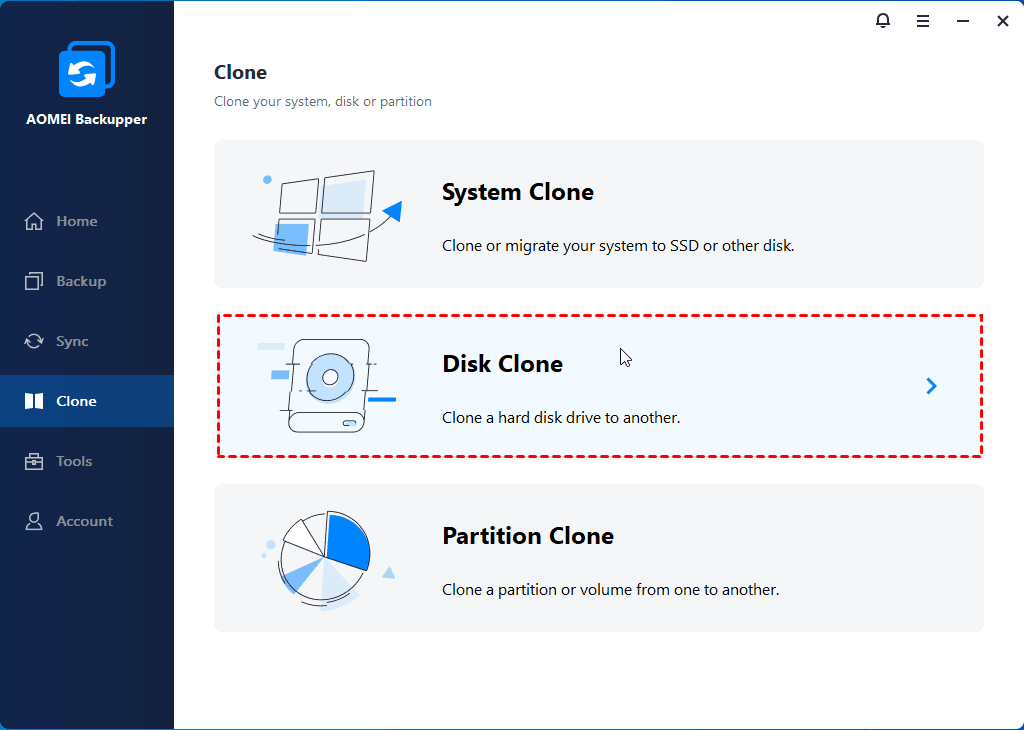
3. Select the UEFI GPT disk as the source disk.
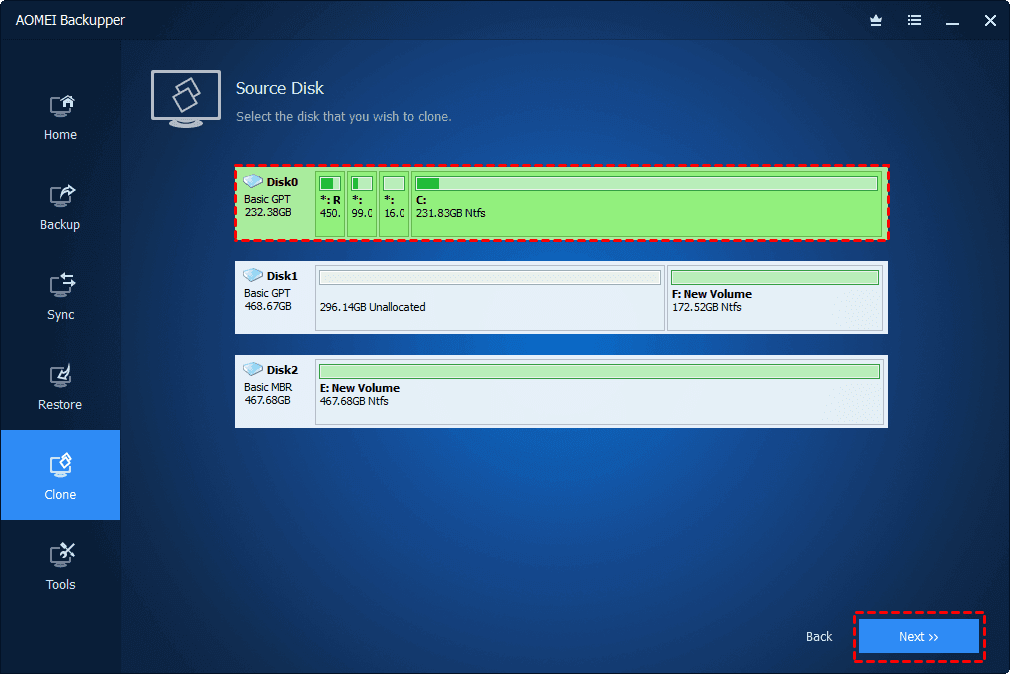
4. Select the MBR SSD as the destination disk.
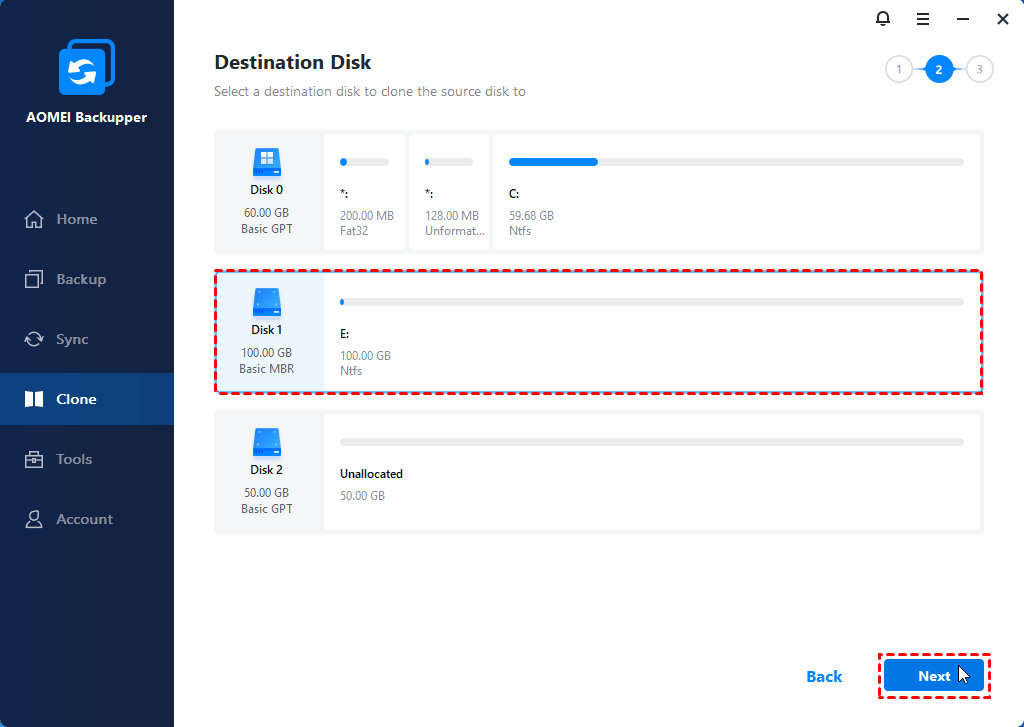
5. At the Operation Summary page, check SSD Alignment and then click Start Clone.
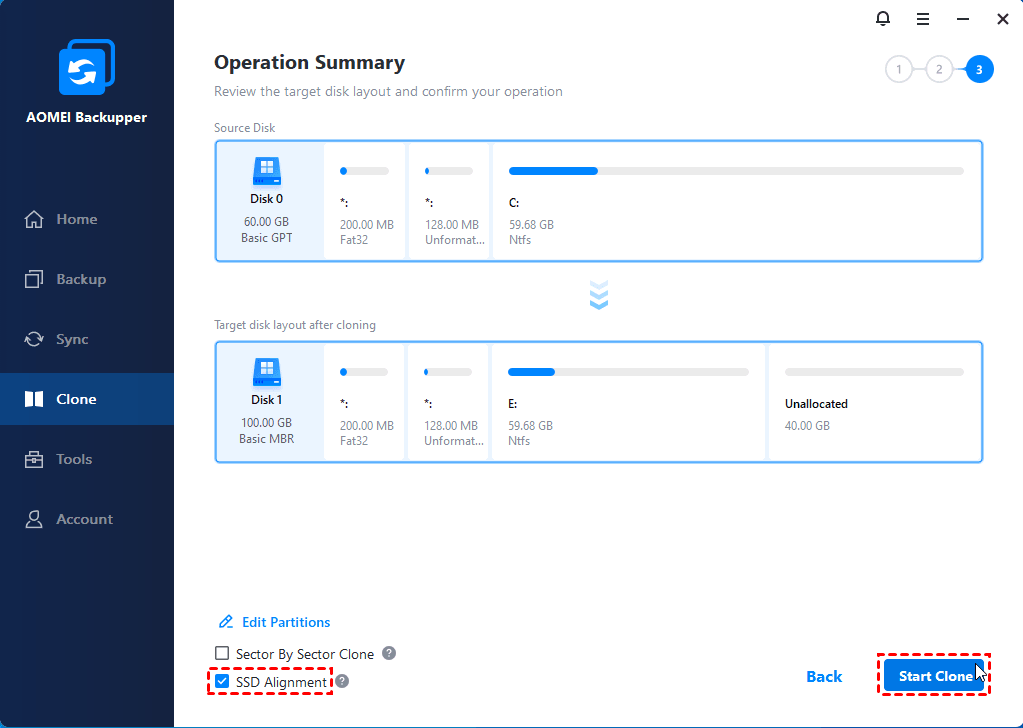
🎯Notes:
💜 Sector by sector clone: by checking this option, you’ll clone all sectors from GPT to MBR SSD, whether it is used or not. This method takes a longer time as well.
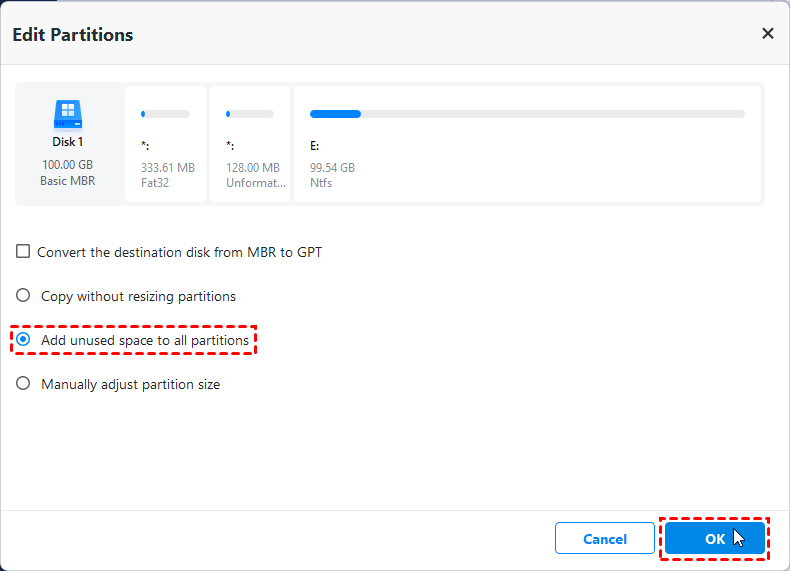
💜 Edit partitions: four options are available in this feature. Please note that checking Sector by sector clone will make this option unavailable.
- Copy without resizing partitions: It will not resize the partition size.
- Add unused space to all partitions: It will reallocate the unallocated space to each partition of the target disk, appropriate for the disk size.
- Manually adjust partition size: It allows you to extend unallocated space to any partition on the destination disk you want.
- Convert the destination disk from MBR to GPT: It helps to convert the partition style of the destination disk if it is different from the source disk.
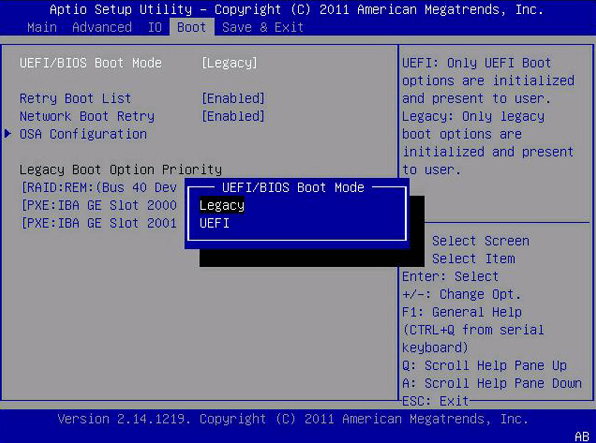
6. Shut down your PC after the cloning process finishes. Power on your machine and keep tapping a specific key (Del or F2) to enter the boot startup. If you do not know which key to press, just press Esc. It will give you the full menu, and then you can select BIOS Setup.
7. Go to the Boot tab and set the MBR SSD as the first boot device. Also, enable Legacy in Boot Mode. Press F10 to save the changes and exit. Restart your computer then.
Way 2. Backup GPT disk and restore to MBR SSD
In case you don’t have a USB-to-SATA cable, or want to move Windows from GPT HDD to MBR SSD on another computer, AOMEI Backupper also provides a way to backup UEFI GPT disk and then restore to MBR SSD. Here are the brief steps.
1. Backup system drive by clicking Backup and then System Backup (or Disk Backup accordingly).
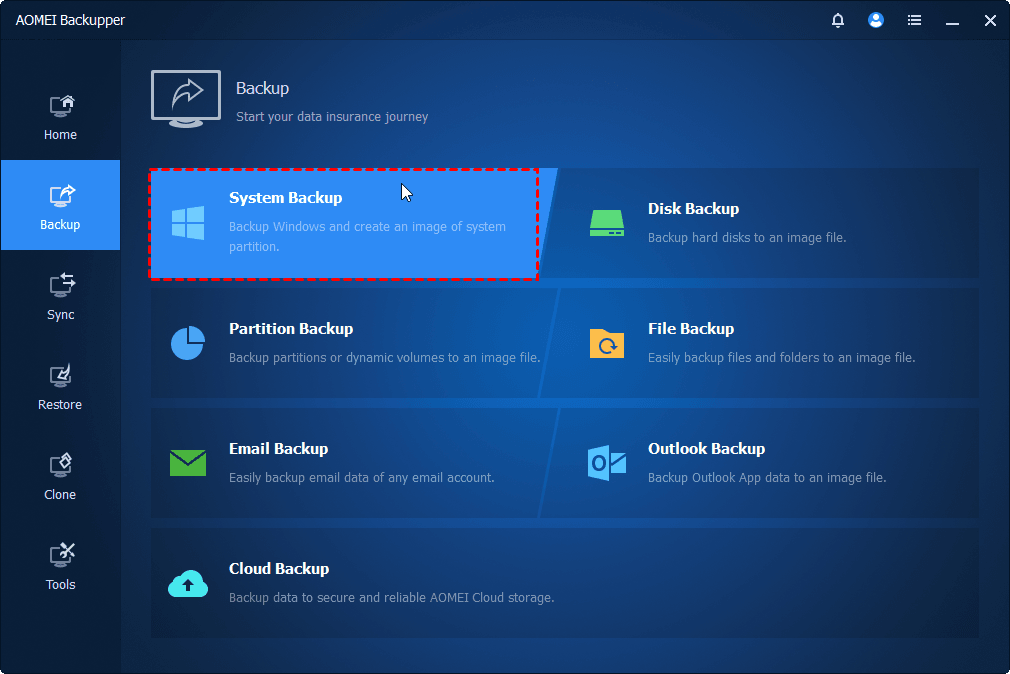
2. All system-related drives are selected by default. Choose the destination path here. You have choices to backup system to USB flash drive, external drive, NAS, network share, etc. Click Start Backup and wait for it to complete.
3. Connect a USB drive to your PC and go Tools > Create Bootable Media to create an AOMEI Backupper pre-installed bootable media.
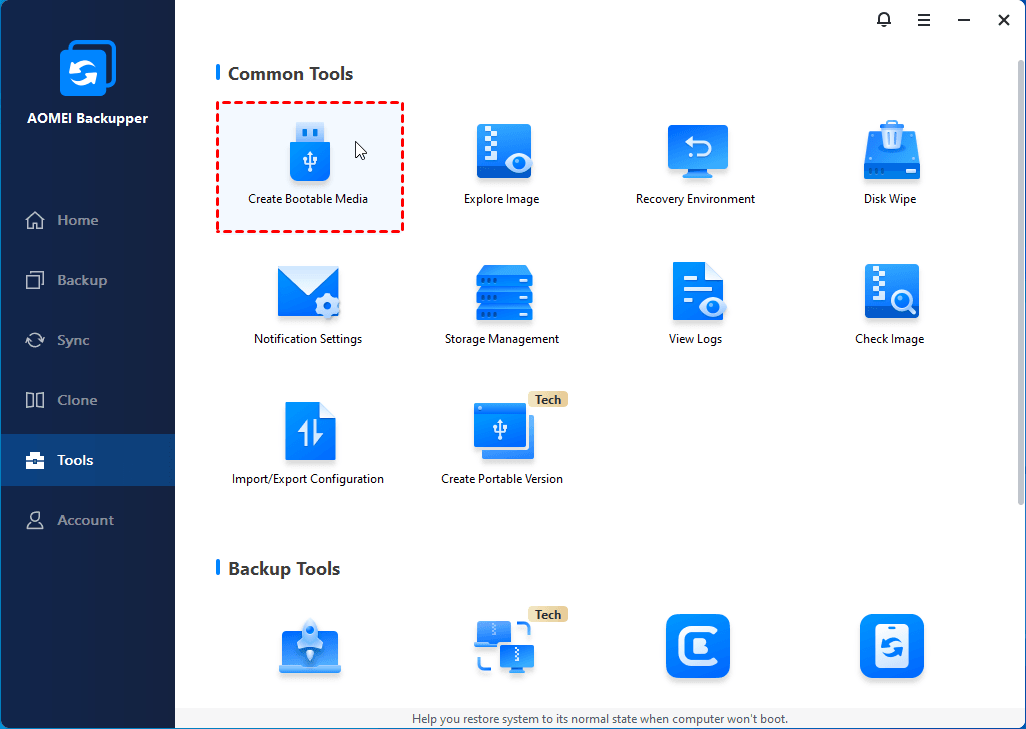
4. Turn off your computer and replace the GPT disk with MBR SSD manually. If moving to a new computer, you can skip this step.
5. Insert the bootable media, power on, and change boot order in BIOS to make your computer boot from the USB.
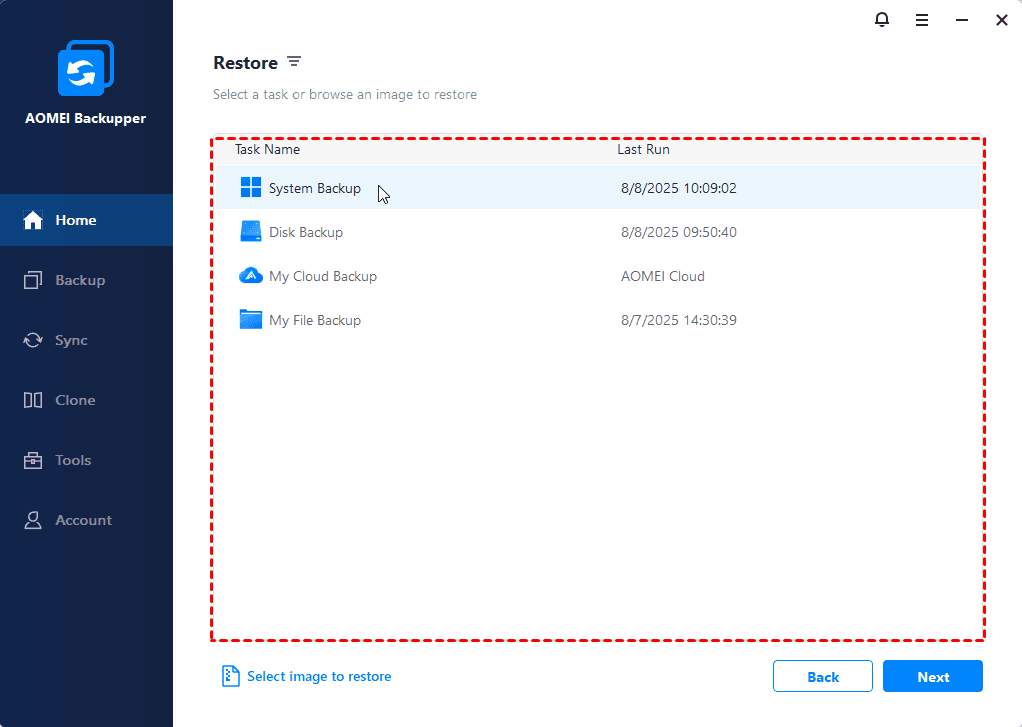
6. Once logged in, you’ll see AOMEI Backupper loaded. Click Restore, access the backup image, and then follow the on-screen guide to continue.
✍Tip: To restore system image to a new computer with dissimilar hardware, you can make use of the Dissimilar Hardware Restore feature.
Bonus: Why perform GPT to MBR clone?
Replacing HDD with SSD is a good upgrade in system startup and program loading, and disk clone is the easiest way to achieve that without reinstalling or data loss. When it comes to partition style, normally we consider GPT to be more advanced and superior to MBR, hence the tendency is to clone MBR HDD to GPT SSD in Windows 11/10/8/7.
However, there are some scenarios that you may need to clone GPT to MBR:
- The target disk is smaller than 2TB and you want to keep it as MBR to avoid unnecessary GPT complexity.
- You want to clone GPT to a different computer that doesn't support booting from GPT disk (so MBR is the only choice).
FAQs about cloning GPT to MBR disk
1. Can I clone a GPT disk to an MBR disk directly?
2. What are the limitations of MBR compared to GPT?
-
MBR supports only up to 2TB of disk space.
-
Maximum 4 primary partitions (or 3 primary + 1 extended).
-
No support for modern UEFI booting, only legacy BIOS boot.
This means if your GPT disk is larger than 2TB, data beyond 2TB cannot be cloned to MBR.
3. What should I do if the cloned MBR disk won’t boot?
-
Set BIOS to Legacy Boot.
-
Use Windows repair tools to rebuild MBR boot files (bootrec /fixmbr, bootrec /fixboot).
-
Check the partition marked as active on the MBR disk.
Verdict
Two available ways are offered by AOMEI Backupper Professional when it comes to clone GPT to MBR disk in Windows. Choose the one that is most suitable for your situation. Apart from clone and backup functions, you can also do real-time sync with said software to keep data protected instantly.
 100% Secure
 100%
Clean & Secure
100%
Clean & Secure